High Artistic Interests + Low Orderliness: The Beautiful Mess
May 9, 2026
High Artistic Interests + Low Orderliness: The Beautiful Mess
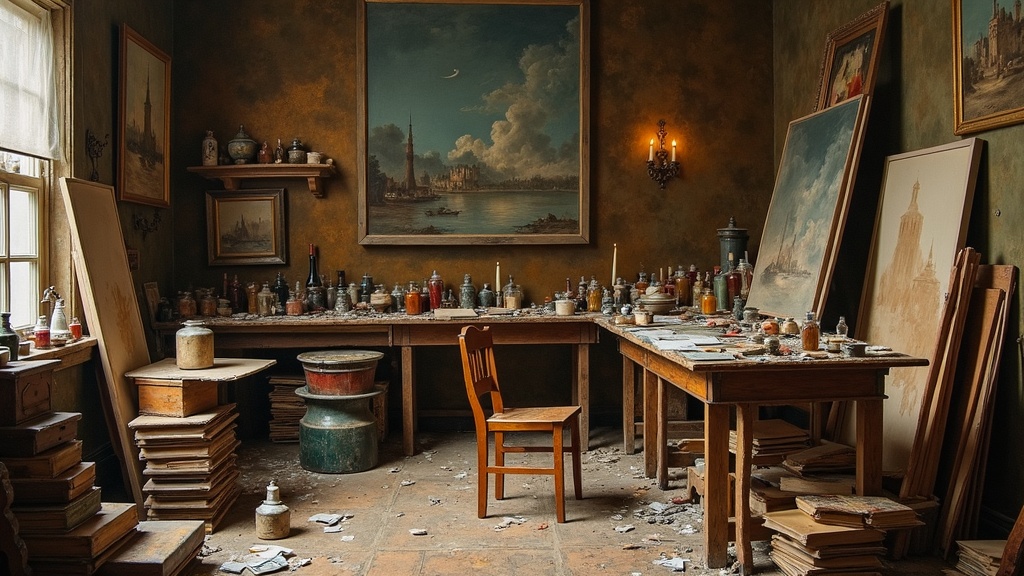
Your desk looks like a disaster. Your closet is a mystery. Your filing system, if it can be called that, consists of piles that only you understand. But your eye for color is impeccable, your taste is sharp, and you notice aesthetic details that most people walk past without a second glance.
If this sounds familiar, you probably score high on Artistic Interests and low on Orderliness, two Big Five personality facets that combine into one of the most recognizable creative profiles.
What Each Facet Means
Artistic Interests is a facet of Openness to Experience. Scoring high means you are genuinely moved by aesthetic experiences. You respond strongly to visual beauty, to music, to well-crafted language. Art is not a peripheral interest for you. It is a lens through which you see and interpret the world.
Orderliness is a facet of Conscientiousness. It measures your preference for structure, organization, and tidiness. Low scorers are comfortable with mess, flexible about plans, and resistant to rigid systems. They tend to let things accumulate, physically and mentally, without feeling distressed.
The Paradox in Action
The Studio That Shocks Visitors
People with this combination often live in spaces that confuse outsiders. There are beautiful objects everywhere: an interesting print leaning against the wall, a ceramic piece on the windowsill, books stacked by some invisible logic. But the space itself is chaotic. Surfaces are covered. Things have not been put away. There is no visible organizational system.
This is not laziness. It is the natural environment of someone who acquires beautiful things but has no internal drive to organize them. Each object was chosen with care and taste. The arrangement, or lack of it, is simply a non-priority.
Research on creative environments supports this. A 2013 study by Vohs, Redden, and Rahinel at the University of Minnesota found that people in messy rooms generated more creative ideas than those in tidy rooms. Disorder appears to stimulate creative thinking by breaking conventional associations.
The Sensory Collector
High Artistic Interests combined with low Orderliness often produces a specific type of collector. Not the organized collector with labeled shelves and cataloged items. The other kind. The person whose home fills gradually with things that caught their eye: a piece of driftwood, vintage postcards, interesting fabrics, rocks with unusual patterns.
These collections have no system. They grow by impulse and aesthetic instinct. A piece of sea glass sits next to a first-edition novel sits next to a dried flower arrangement that is six months old. The collection makes emotional and visual sense to you. To anyone else, it looks like hoarding.
Creative Process Without a Process
People with this combination tend to approach creative work in a way that horrifies structured thinkers. There is no outline. There is no plan. There is no consistent schedule. Work happens in bursts of inspiration, often at odd hours, often in response to something that sparked an idea.
The results can be remarkable. Research on creative cognition suggests that less structured thinking allows for more associative leaps, the kind of unexpected connections that produce original work (Martindale, 1999). When you are not following a plan, you are free to follow an idea wherever it leads.
The downside is equally real. Projects stall when inspiration fades. Deadlines feel like prison sentences. The gap between the vision in your head and the discipline required to execute it can feel enormous.
How This Shows Up in Daily Life
Kitchen Aesthetics
A small but telling example: people with this combination often have beautiful kitchens that are functionally chaotic. The spice collection is visually stunning, arranged by the colors of the jars rather than alphabetically. The cookbooks are chosen as much for their covers as their recipes. The kitchen tools are attractive but stored in no logical order.
Cooking tends to be improvisational. Recipes are suggestions, not instructions. Measurements are approximate. The result is sometimes brilliant and sometimes a disaster, but it is never boring.
The Wardrobe Situation
Getting dressed is an aesthetic experience, not a logistical one. You are drawn to interesting textures, unusual colors, and pieces that make you feel something. But your closet is a tangle. Clean and dirty clothes may coexist in ambiguous piles. You own beautiful things you cannot find when you need them.
The person who shows up to a meeting in a strikingly original outfit and then cannot locate a matching pen is often someone with this particular combination.
Work and Deadlines
In professional settings, this combination creates a predictable tension. You produce work that is aesthetically distinctive and often more creative than what your structured colleagues produce. But you produce it at the last possible moment, surrounded by disorder, in a process that looks like barely controlled chaos from the outside.
Managers either love you or find you maddening. Often both.
The Friction Points
Shared Living Spaces
The most common source of conflict for people with this combination is living with someone who values orderliness. Your beautiful mess is intolerable to someone who needs visual order to feel calm. Their organized space feels sterile and lifeless to you.
Neither position is wrong. But the gap between them can be enormous, and it often requires explicit negotiation rather than the assumption that one person's standard is "correct."
Lost Potential
The deeper cost of this combination is unfinished work. Your artistic sensibility generates ideas constantly. Your low orderliness means many of those ideas never get organized into a form that can be completed and shared. The notebook full of half-developed concepts, the folder of started-but-abandoned projects, the idea that was brilliant at 2 AM and forgotten by morning because you did not write it down in a findable place.
Over a lifetime, the accumulated weight of half-realized ideas can become a source of real regret.
Working With This Combination
External Structure, Not Internal Discipline
You are unlikely to develop strong internal orderliness. Research on personality stability (Roberts & Mroczek, 2008) shows that traits can shift gradually over decades, but dramatic change is rare. Instead, build external systems that compensate.
Use a single notebook for all ideas. Use a digital tool that captures everything in one place. Set phone reminders for deadlines. The key is that the system must be simple enough that you actually use it. Elaborate organizational systems will be abandoned within a week.
Protect the Mess Where It Matters
Not all disorder needs fixing. If your creative space is messy and your work is good, the mess is not a problem. It is a feature. Research consistently shows that creative individuals tend toward lower orderliness (Feist, 1998). Trying to force tidiness on your creative process may actually reduce the quality of your output.
The distinction is between productive disorder (the studio where you work well) and destructive disorder (the tax documents you cannot find, the important email buried in a chaotic inbox).
Batch the Boring Stuff
Since organizational tasks feel aversive to you, batch them. Set one hour per week to deal with filing, cleaning, responding to administrative emails. Do it all at once, treat it like paying rent, and then go back to the interesting work. Short concentrated bursts of organization are more sustainable than trying to maintain order continuously.
The Upside
At its best, this combination produces people with extraordinary taste and genuine creative instinct. You see the world differently than organized people do. Your willingness to let things stay messy, physically and mentally, allows for combinations and connections that a tidy mind would never make.
The beautiful mess is not a failure of character. It is the natural landscape of a mind that prioritizes aesthetic experience over systematic order. And the world needs that.
Want to see where you score on Artistic Interests, Orderliness, and 28 other personality facets? Take the free Big Five quiz at Inkli and discover your full personality portrait.