High Imagination + Low Gregariousness: What This Personality Combination Means
August 6, 2026
High Imagination + Low Gregariousness: The Creative Loner
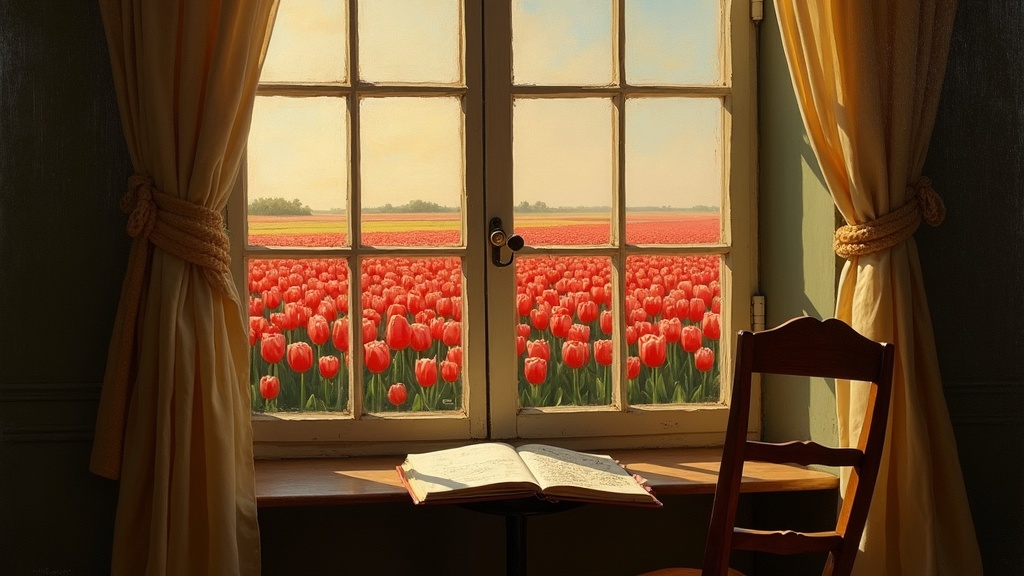
The party is downstairs. You are in a quiet room with a book, a window, and the most interesting thing happening inside your own head.
This is the pattern of high Imagination (Openness facet O1) combined with low Gregariousness (Extraversion facet E2). While the previous post in this series explored Imagination paired with low Friendliness (warmth), this combination is specifically about social preference and group behavior. People with this pairing are not cold or unfeeling. They simply find groups exhausting and solitude fascinating.
The Facets
Imagination is the Openness facet that measures how actively your mind generates mental imagery, hypothetical scenarios, and novel ideas. High scorers have a rich inner landscape that keeps them mentally occupied and intellectually stimulated, often without any external input at all (McCrae, 1987).
Gregariousness is the Extraversion facet that captures your preference for social contact, specifically your desire to be around groups of people. High scorers seek out social gatherings, feel energized by crowds, and prefer company to solitude. Low scorers prefer being alone or with one or two people at most. They find group settings draining rather than energizing and will actively avoid social situations that involve many people.
Unlike Friendliness, which is about warmth, Gregariousness is about quantity. Low Friendliness means you are not warm. Low Gregariousness means you do not want to be around groups. A person can be warm and non-gregarious (friendly in one-on-one settings but avoidant of crowds) or cold and gregarious (not warm but still drawn to social activity). These are independent traits.
Why Imagination Amplifies the Solitude Preference
People with low Gregariousness generally prefer less social contact. But people with high Imagination and low Gregariousness have a specific reason for their preference: they have something better to do.
This is not avoidance. It is active preference. When your mind generates a continuous stream of interesting scenarios, connections, and possibilities, a quiet room is not empty. It is the stage for a rich cognitive performance that other people can only interrupt.
Storr (1988) wrote an entire book, "Solitude: A Return to the Self," arguing that many of the most creative minds in history were specifically low on gregariousness. His thesis was that solitary time is not just tolerable for creative people but necessary, because the kind of deep, associative thinking that produces original work requires the absence of social interruption.
For people with this facet combination, Storr's observation is not a philosophical position. It is a daily lived experience. Groups fracture attention. Conversation imposes its own rhythm. Social environments demand a kind of responsive, present-moment engagement that is fundamentally different from the open-ended, self-directed exploration that high Imagination produces.
The Behavioral Pattern
If you score high on Imagination and low on Gregariousness, you are probably the person who:
- Arrives at social events already calculating when you can leave, not because you dislike the people but because you know your energy for group interaction is limited and finite
- Does your most interesting thinking during long walks alone, late-night solo sessions, or quiet mornings before anyone else is awake
- Has turned down invitations not because you were busy but because you would genuinely rather be alone with your thoughts
- Finds that group brainstorming sessions produce worse ideas (for you) than solo thinking, even though the research supposedly supports collaboration
- Maintains a few deep relationships rather than a wide social network, and those few relationships are often with other people who prefer depth over breadth
- Gets described as a "loner" by people who think that word is negative, while you hear it as an accurate and perfectly acceptable description
That point about group brainstorming is well-supported by research. Diehl and Stroebe (1987) found that individuals brainstorming alone actually generate more ideas, and more original ideas, than the same number of people brainstorming together. The social dynamics of groups, turn-taking, evaluation apprehension, production blocking, interfere with the free-associative process that produces novel ideas. For someone with high Imagination, group brainstorming is not just less pleasant. It is measurably less productive.
Solitude as Creative Infrastructure
Long (2003) studied people who actively chose solitude and found that those with rich inner lives, high on what she called "aloneness capacity," were psychologically healthier and more creative than people who were alone but did not have the inner resources to use solitude productively.
This is the key distinction. Low Gregariousness without high Imagination can produce loneliness: being alone with nothing to do and no one to see. Low Gregariousness with high Imagination produces solitude: being alone with a mind that is fully, pleasantly occupied.
The difference between loneliness and solitude is not the presence of other people. It is the presence of something engaging happening internally. People with this facet combination rarely experience loneliness in the traditional sense, because their minds are too active to be bored.
The Professional Implications
People with this combination often gravitate toward work that can be done independently. Writing, research, programming, design, analysis, and creative work of all kinds attract this personality type because these activities reward deep solo focus and do not require constant social coordination.
They struggle most in roles that require sustained group interaction: open-plan offices, frequent meetings, team-based project management, client-facing roles that involve entertaining, and any position where physical presence in a social setting is treated as evidence of commitment.
Grant, Gino, and Hofmann (2011) found that introverted leaders actually produced better outcomes with proactive teams than extraverted leaders did, because introverted leaders listened more carefully and gave team members more space to contribute. People with high Imagination and low Gregariousness can be effective leaders in the right context. But that context needs to respect their need for solitary processing time, not punish it.
The Cultural Mismatch
Western culture, particularly American culture, treats gregariousness as a default virtue. Networking events, open offices, team lunches, and after-work socializing are all built on the assumption that more social contact is better.
For people with this combination, this creates constant, low-grade friction. They are not anti-social in any meaningful sense. They are simply not wired for the quantity of social interaction that their environment treats as normal. The result is a persistent feeling of being slightly out of step with expectations, not enough to cause crisis but enough to feel like you are always performing a role that does not fit.
Working With the Pattern
The most important thing people with this combination can do is stop apologizing for their solitude preference. It is not a deficiency. It is a feature of a personality that channels energy inward toward creative thinking rather than outward toward social engagement.
Practically, this means structuring work and life to include reliable blocks of solitary time. It means choosing living situations, jobs, and relationships that respect the need for alone time rather than treating it as a problem to be solved. And it means recognizing that the creative output this personality generates depends on that solitude, which means protecting it is not selfish. It is functional.
Curious where you actually fall on these dimensions? Take the free Big Five personality quiz and find out which of the 30 facets define your specific personality pattern.